
Pieter Bruegel the Elder (c. 1525-1569). The Human Face of the Renaissance
Pieter Bruegel the Elder was born around 1525 and died in 1569. He worked mainly in Antwerp and Brussels. He was a painter and a highly important draftsman, deeply attuned to new ideas about the world, which he reflects in the content of many of his pictures. Yet in terms of style, he is perhaps the least Italianized of the great European artists of the 16th century. In The Harvesters, his figures don’t recall classical statues, and he painted no nudes. His style follows the example of Bosch and Patinir, and in his themes he draws from popular culture and folklore. Bruegel is the key figure in the growth of a way of painting seen as an alternative to the classical tradition. Many of his works focus not on heroes of religion, ancient mythology, or history, but on common folk engaged in scenes that feel taken from everyday life. We know this type of painting as genre painting. It became very popular in the 17th century, especially in the Netherlands. The Harvesters is one of close to forty paintings known by Bruegel. Painted in 1565 near the end of his life, it belongs to a group of six works showing different times of the year. It is now in the Metropolitan Museum of Art in New York. Most of the other scenes in this seasons series are in one of Europe’s great painting collections, the Kunsthistorisches Museum (Museum of the History of Art) in Vienna. You really need to go there to see Bruegel properly. It was common in the 16th century to represent parts of the year as a way of organizing time. This scene evokes the humid heat of a summer day. There are no heroes, gods, or saints here—just peasants absorbed in everyday life. Many work in the fields harvesting grain; some don’t show their faces, which makes them seem mechanical. In the foreground a group eats and drinks, and one person naps. Beyond a moment in the life of peasants, there’s a sense that we are witnessing something else: a different level of meaning where judgment is involved. Much has been written about the meaning of Bruegel’s peasant paintings, which remains unclear. These works were made for city dwellers, who held conflicting views of peasants—either as unpolished and uncivilized or as uncontaminated and pure. The latter seems more likely here. Implicit in the realism is respect for a way of life: nature and those who work the land are part of the same time-tested, all-encompassing system. The round eyes of the man beside the tree who looks out at us are characteristic of Bruegel; there’s something quizzical about him. Bruegel’s art is marked by a deep sense of humanity. Notice the expansive landscape, inspired by Patinir. One of the great qualities of Bruegel’s works that doesn’t show in reproductions is the enormity he conveys when painting nature—and the smallness of our presence in comparison. Writers often use the word “cosmic” when discussing Bruegel’s art. Few artists rival Bruegel’s ability to evoke the immensity one feels before a night sky full of stars, the sense that we belong to something larger than ourselves. To feel this fully, look at other works in the seasons series or The Conversion of Saint Paul, all in Vienna. Another key feature of Bruegel’s art emerges here: despite their apparent realism, his paintings are highly designed. Note the sinuous shape of the large patches of grain waiting to be harvested; their contours merge with a curving path that extends into the background at left. The large tree, carefully placed off-center, overlaps with other trees and with the church beyond. These elements are deliberately clustered—very characteristic of the artist. The confusing pattern of intertwining branches echoes the endless variety of nature and emphasizes its effect on us. In many other paintings, trees and houses also define the character of the composition. Bruegel made many drawings, some intended for prints. Big Fish Eat Little Fish follows a drawing by Bruegel from 1556. The printmaking technique is engraving: a specialist reproduced the drawing on a copperplate by incising the metal with a burin, the tool shown here. Ink applied to the plate filled the incised lines, and when the plate was pressed onto paper, the lines printed in reverse. The engraving was published by Hieronymus Cock, an Antwerp-based art dealer, artist, and a highly important publisher. In the lower left he added an inscription claiming the design was by Bosch. As a businessman, he believed he could make more money selling the image as Bosch than as Bruegel. The inscriptions at the bottom explain its theme: in Latin, “little fish are the food of big fish,” and in Dutch, “look, son, I have long known that the big fish eat the small.” The scene confirms this idea throughout: a child on a boat points to a man extracting fish from another’s stomach, and at left a fish with legs carries another in its mouth. It’s clear that the lesson applies to humans as much as to fish. This print shows the side of Bruegel closest to Bosch, and he made a number of paintings that resemble his predecessor. One of the best examples is The Triumph of Death, a large painting from 1562 now in the Prado Museum. At its center, a skeleton on horseback with a sickle leads the forces that bring life on earth to an end. Armies of the dead approach from the distance and rise from the ground. The hellish landscape echoes Bosch and reflects the constant reality of devastating religious wars of the time. At bottom left, a king is reminded of the triumph of time and death over his power by a skeleton with an hourglass, while another skeleton strips his riches. Four similar groups of two or three figures are spread along the lower edge, forming a pattern. At center, a skeleton cuts the throat of a pilgrim; at right, a pair of lovers fits along the angle of the picture’s corner. Works like this earned Bruegel the label “a new Bosch.” Spend time with its details.
Images in video: Pieter Bruegel the Elder (c. 1525-1569). The Human Face of the Renaissance
Portrait of Pieter Bruegel the Elder, included in the book Pictorum aliquot celebrium Germaniae inferioris efigies, by Dominicus Lampsonius, published in 1572
Pieter Bruegel the Elder, The Harvesters, 1565, 119 x 162 cm,
New York, The Metropolitan Museum of Art
Pieter van der Heyden, after Pieter Bruegel the Elder, Big Fish Eat Little Fish, published by Hieronymus Cock in 1557, engraving, first state of four, 261 x 337 mm,
New York, The Metropolitan Museum of Art
Detail of the process of engraving, illustration from Diderot’s Encyclopédie
Pieter Bruegel the Elder, The Triumph of Death, c. 1562-1563, 117 x 162 cm,
Madrid, Museo Nacional del Prado
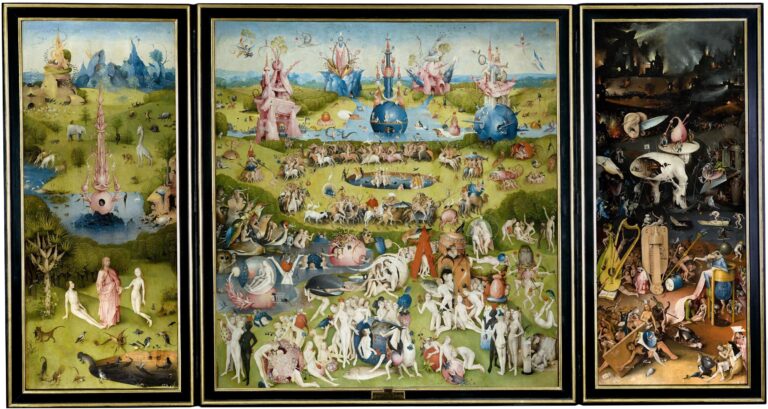
Hieronymus Bosch
Michelangelo (1475-1564). Renaissance Grandeur
Further reading
Michelangelo (1475-1564). Renaissance Grandeur