ROBERT HUBERT
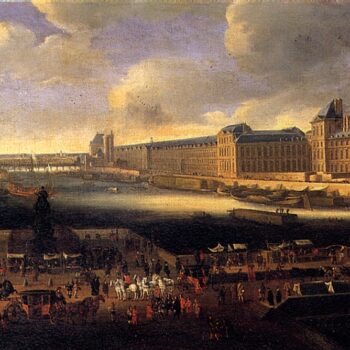
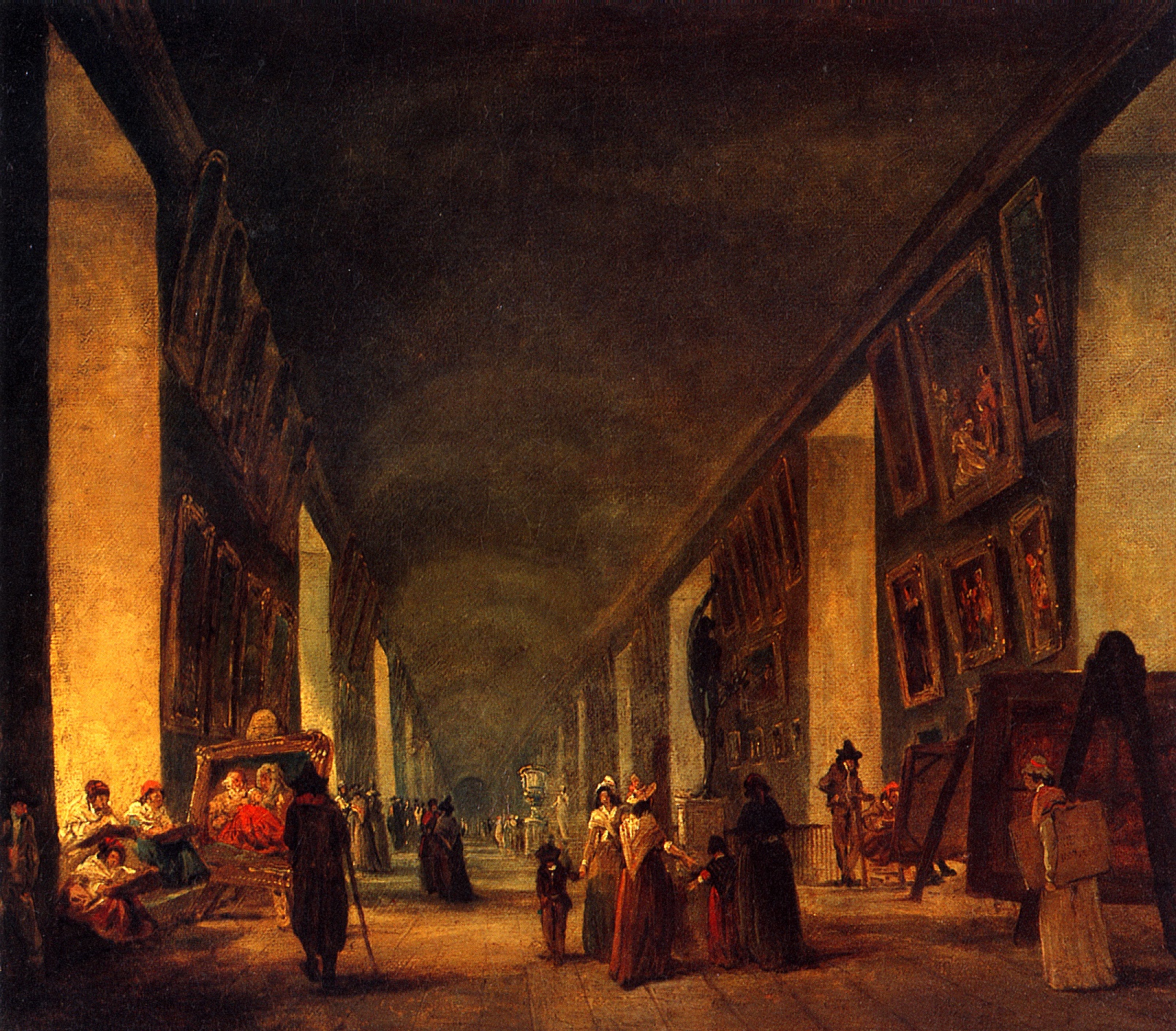
Gallery of Louvre between 1794-1796. (Louvre, R.F. 1948-36. MN. Hubert Robert who created many projects of reconstruction of Louvre left also detailed verbal description of an appearance of Louvre when became his saver.)
To the midpoint of the XVI century the French court art did not depend on foreign influences any more and developed self-contained therefore also the quantity of foreign patterns in a meeting of Fontainebleau almost did not increase. After 1527 Louvre, the lock on the right coast of Seine considerably rebuilt according to its new function becomes the official royal residence. Extended galleries of the state apartments around the huge yards comparable on the scale only to Vatican, by the end of reign of Francis I found excellent application and for other purposes.
The basis of the Fontainebleau collection was made by a small number of masterpieces of the Florentine and Roman painting of the High Renaissance. But also another, the bulk of a collection was selected not with smaller workmanship. If as it is supposed, already then entered into Francis I’s meetingthe artist (see) paintbrushes Giovanni Savoldo, belonging absolutely other, Venetian tradition, then it is necessary to recognize that the king possessed a broad outlook and refined taste. That ease to what Savoldo is coordinated in the composition by the character and his turning aside in mirrors, is borrowed, undoubtedly, Giorgione. The third mirror thinks the artist with his capability of turning aside of reality and particular methodology of this turning aside here.
Francois Cloue and Corneille de Lyon’s several small room portraits – the most characteristic works of that time – came to a collection during later era. In case of Henry II (rule 1547-1559), as we know, sculptural facades of Jean Goujon in the Square yard were main “acquisition” of Louvre. These facades – together with the caryatids of operation of Pierre Lescaut executed too in the middle of the XVI century – laid the foundation for that quiet majesty which will remain also in the subsequent development of ensemble. Louvre is the single museum which decorative design incorporated works of artists of the highest level. In the XVII century Giovanni Romanelli and Charles Lebren, in the 19th and 20th centuries – Ingres, Delacroix and Braque worked here.
Construction in case of Henry IV (rule 1589-1610) of the hall, huge on expansion (apprx. 420 m in length), connected both palaces from the river became the most important total in the Tuileries Palace construction (it is reserved in 1563 by Ekaterina Medici). This Big gallery was fated to become a basis of future museum. The plan according to which it was mortgaged in 1608 showed that the king intended it for public use as the museum of art. On the first floor living accommodations and workshops for artists, sculptors and the skillful masters handicraftsmen – were provided as was within two centuries, up to the structure of the Museum of Napoleon. Probably, in the same place it was supposed to place representatives of noble estate, “to strengthen the union between the aristocracy to it and fine arts”.