Morse Samuel
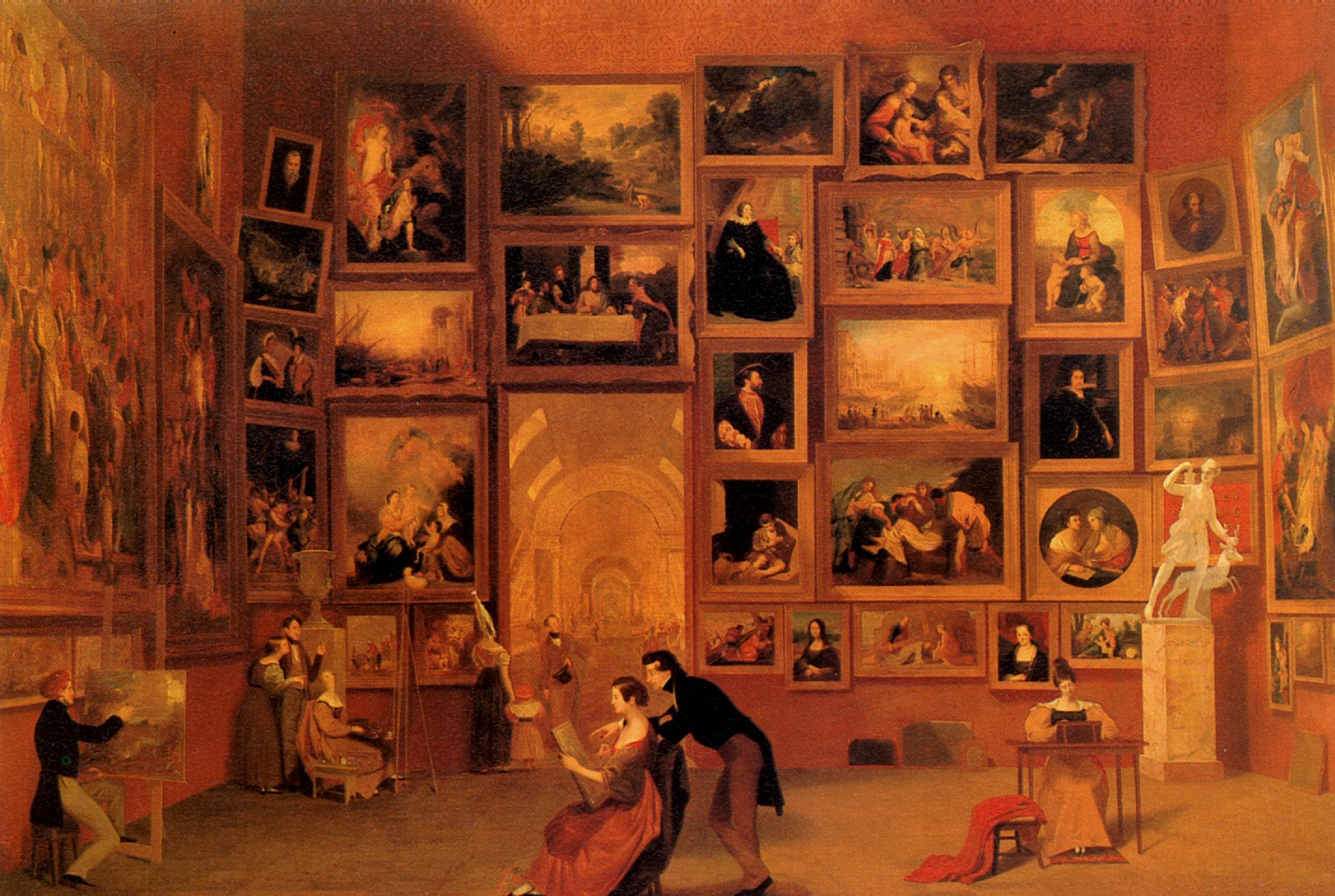
Samuel Morse in the field of a pattern with the image of Square Interior managed to contain very many luvre masterpieces; actually works much larger and hang in different halls of the museum. The artist figured himself in the forefront, the writer James Fenimore Cooper with the spouse Susan Delonsey Cooper and their daughter – in the left corner of location near an easel. (1832 Terra Muzeum of Arth, Chicago, Illinois. The photo is provided by the museum Terra)
As a result the greatest emperor of Modern times named the greatest museum – the circumstance which was completely responding to the atmosphere of imperial privileges which surrounded a collection from the very beginning.
Legal conclusions around Napoleon’s Museum were very interesting. Nobody doubted that ownership of the greatest art gave advantage which reigning collectors had always. It is clear, that France was the natural successor of Ancient Rome on which sample she herself also equipped. If France was predetermined to inherit treasures of antiquity, then it was even more lawful to own art masterpieces of all cultural eras following antiquity. As F.H. Taylor reports, the particular obligation consisted in it: “The French people which are by nature gifted with distinguished perception, seeing antiquity samples, will exercise the feelings and the critical mind”. Eventually the general judgement affirmed that France most was suitable for execution of the museological mission. The artists who countenanced it, and among them there are Jean-Baptiste Izabe and Francois Gerard, were supported by the public when expressed an opinion that “The French Republic thanks to the force, the culture and the advanced artists is the single country in the pattern capable to shelter safe to these masterpieces”.
It was felt that the French art of former sense was not worthy to have broad influence. Only rigorous classicism could compensate his lameness. As affirmed – “All nations will shall study at our art, the same as once they imitated our frivolity”. The novel specie of cultural nationalism extended. Napoleon with all the Corsican categoricalness wrote in 1796 from Milan the following: “All geniuses, all those someone moved forward in the field of literature [he could add – “and fine arts”], are the French irrespective of in what country they were born”. Such statement in itself looks extremely shovinistic and absolutely unacceptable, however in case of a retrospective view of history of fine arts after 1796 and considering that role which Louvre happened to play in it, it is necessary to recognize that in the particular relation it turned out to be true. None other than Napoleon, can be read by the genius, but also the fact that all persons vested with talent came to the same judgement that they were grown by France and the art collection belonging the French nation when it endured the star periods is unconditional.
1802 became one of such periods for Louvre. The larger gallery remained in inviolability year or two. In 1804 it was closed again for the device of overhead lighting and a construction of poles which were figured in the pattern by Hubert Robert. In 1802 under the Amiens peace treaty it was authorized to make trips to Paris, mainly to British for whom the city remained unavailable twenty years. It seemed that Paris became the place of a pilgrimage of the whole nation, and among these pilgrims there was both an outstanding artist William Turner, and the famous political figure Charles James to Foka, and American Benjamin West, the Quaker from Pennsylvania who became the president of Royal Academy in London. West very strongly influenced change of tastes in Paris in 1802. In 1760 it anticipated a tendency to neoclassicism at the head of which in France there was Jacques Louis David. But B. West continued to develop further, having executed a huge pattern of 0¤ ¤Смерть _0_1_0 on a pale horse of 0¤ ¤ _0_0_0 in the late, baroque and romantic manner (nowadays in Philadelphia, in the Pennsylvanian Academy; here it is not provided). The pattern was intended for an exhibition in Paris where artists celebrated West, calling him “the English newcomer”, along with the chief representative of the French neoclassicism Zh.L. David.
Catremer de Quensi accompanying Napoleon in campaigns wrote that that “was obsessed with thirst of the best things in each country in advance”. And still not only Paris held a privileged position in art processes of an era of Napoleon and Vivan-Denon. Napoleon permanently got back to the idea of galleries branches or even the national museums in which the patterns finding communication with the French tradition and which would appear peculiar “departments” of France on places would be distributed. In 1800 he decided to found fifteen such museums, including in Brussels. More than eight hundred patterns taken from Louvre and Versailles were sent to provinces.
The capitals of new Europe controlled the emperor’s relatives received own museums. Their organization depended on the French initiative. In 1808 Louis Bonaparte founded the museum nowadays known as Reyksmuzeum in Amsterdam. Gérôme Bonaparte governing in Westphalia continued construction of gallery in Kassel. Museo del Prado in Madrid (it is conceived by Joseph Bonaparte) was open already during Restoration in 1814 by Ferdinand VII. Brer’s picture gallery in Milan and Academy in Bologna were founded in 1809. The Brera gallery is obliged by the main treasures to Evgeny Bogarne’s generosity. Later the regional museums outside France received patterns from the French royal collection. Rubens’s patterns provided to Brussels were purchased in due time by Louis XVI. Napoleon’s museum was conceived as educational center and a sample of the museum for the whole Europe. The museums are spiritual clothes of the nation. The revolutionary example excited universal creation of the museums or local authorities, as in Antwerp, or private supporters as what Karraro’s family in Bergamo acted. These spiritual clothes remained. When Napoleon was deposed, and confiscated by him in other countries was confiscated, often it returned not to churches from where it was excepted, and in art galleries as it happened in Parma and Venice.
At the same time Vivan-Denon imagined more and more clearly what is not enough in a collection of the patterns, in the majority “acquired” thanks to act of war. The Luvrsky fund of the Italian painting could not satisfy yet interest in early Renaissance painting which was more narrow widely is provided among “primitives” in David’s workshop and also in meetings of Germany and Rome. And in 1811, having gone to Tuscany for searching of what else there remained from an early art legacy, Vivan-Denon considerably succeeded in it. In church of Franciscans in Pisa it acquired Chimabue and Giotto’s those works which also nowadays open the section of the Italian painting in Big gallery. That there was a magnificent example of system collecting, and the exhibition catalog, arranged upon return of Vivan-Denon, included, in addition to Chimabue and Giotto’s altars, at least significant works to Fra Anzheliko, Filippa Lippi, Lorenzo di Credi, Domenico Ghirlandaio and Cima da Coneglijano.
Huge expansion of exposure in Big gallery gives the fine chance for building of the historical concept. In 1802 the English traveler Cecil Gould so described the effect which had by gallery. According to her, quitting Square Interior which in comparison with Royal Academy in London makes “about two areas of its exhibit room, you get… in such gallery, what light did not see yet. Such lengthiest that its perspective meets almost in one point, and so rich that the spectator continually, though feels that it is necessary to go further, it is arrested by a look to the finest patterns what he ever saw…”.
Vivan-Denon was guided by the idea of progressive development of art as treated it George Vazari, and Napoleonic classicism, kind of newly rising the idea of the High Renaissance was the culmination for it. In Louvre this culmination which is classical in an absolute word sense – deification of history which active participant was at that moment Louvre is also until now felt.
After falling of the empire in 1815 return stolen was the beneficent act of redemption. When compensating was completed, there was exactly a half of the patterns taken from Italy and which origin was known. The French treated them more better, than their former owners, and their significance revealed in Louvre more. Representatives of Tuscany refused the masterpieces among which there were operations of Chimabue and Perudzhino; they were interested in the Florentine inlaid marble desktops more. The solution Vivan-Denona in 1811 to acquire the Tuscan masterpieces received, thereby, legal confirmation, and same it is possible to tell concerning its methods which were going back to Francis I. David and Vivan-Denon, these two solid persons, hardly realized that they gave pulse and point of reference for art of two subsequent centuries. Animated them – and it is how uncontrollable! – general faith. The only thing that was required to the citizen of the great country, is to inherit the richest, absolute past experience, to experience the most noble and most rigorous qualities of graphic skill. With these beliefs France and all educated world went to the future.
In 1832 Samuel Morse, the American artist and the inventor of the telegraph code, completed a pattern on which it worked fourteen months. Its figured by Square Interior and, through door opening, the infinite perspective of Big gallery. Walls of Interior, beginning from paneling and to eaves, more than forty are covered with the most known masterpieces of a collection, and them here. Morse saw the task in the evident and thought-over show of all western painting. Assignment of this book not much more differs from this intention.