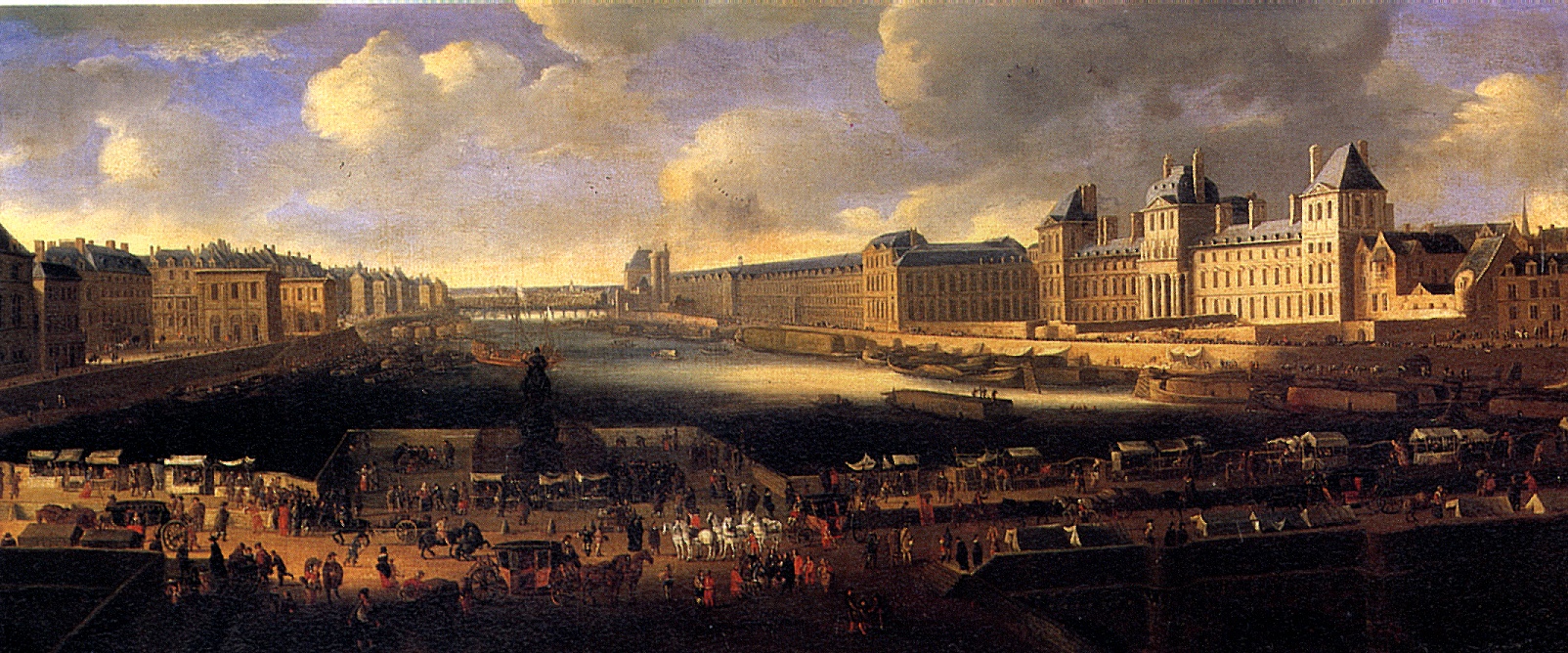
Panoram of Paris in the 17th century overlooking Louvre from the New bridge.
to Louvre is visible on the right coast; buildings then of yet not finished Square yard are most closer to the New bridge; The Larger gallery is pulled along the river, its distant end is adjoined by the Tuileries palace. (French school, MN)
When Louvre which received the name “Main Museum of art” after the Revolution opened at last the doors on August 10, 1793, exposure of the museum was located in the same Big gallery which rather decayed and which got out of fashion. Its interior which in the beginning is only a little repaired received brand new design in case of Napoleon, in the period of the First Empire (1805-1810) when Charles Persie and Pierre Fontaine, relying on aged intentions of Hubert Robert, built arches with crosspieces and partially – overhead lighting. On the first floor where Anna Avstriyskaya’s apartments were placed, in the Hall of caryatids and in the southern side panel of the Square yard, by this time again repaired, antique collections were placed.
It was a brilliant era – an era of the Museum of Napoleon, once ephemeral museum dream who was fated to become a pre-image for many museums XIX of century.
In the period of the First Empire there were significant changes. Operations in the Square yard were finished, opposite to an input to the imperial residence Tuileries built the Triumphal arch and, the most important, working on by “the larger plan” (grand dessein) of Henry IV – from the North was continued, along new Rivoli Street exponentation of a side panel which supposed to connect (symmetrically Big gallery) Tuileries and Louvre began.
During Restoration of a dynasty of Burbons (1814-1830) for Louvre there came times of trouble. In 1815 its many masterpieces left Paris, having returned home. Then short, but very fruitful period of new arrivals, especially in a collection of antiquities, a sculpture and applied art – objets d’art followed. On the second floor of the southern side panel of the Square yard, in “Charles X’s Museum” which ceilings are decorated with very interesting subject paintings location for the Egyptian collection was framed. In Louis-Philip (1830-1848) reign, in connection with large-scale architectural works on creation of the Museum of history of France in Versailles, magnificent exhibits of the Spanish gallery of the Palace of Versailles were exposed in Louvre. After the revolution of 1848 a part them was sold at the London auction.
The second Republic (1848-1852) and the Second Empire (1852-1870) were marked by new surge of architectural and museum activities. Louvre which received the name Palace of the People in 1848 was completely repaired and converted. The architect Dyuban completed finishing of a row of facades, gave a monumental appearance to Square Interior and Interior of seven fireplaces, finished design of Gallery of Apollo which central part was painted by Eugène Delacroix (1851). In new side panels the ministerial organizations which added that were in the imperial residence in Tuileries were placed.
Napoléon III personally tracked completion of this project, making decisions according to the plans developed by Louis Visconti. Last entered a constituent part the project of reconstruction of Paris, for which the baron Zh.E. Osmann was responsible. Reconstruction was intended to emphasize prestige of all-powerful state again. To the North, along Rivoli Street, the palace was shorted by the side panel stretched from Tuileries to the Square yard. The extensive rectangle received at last the completion. New symmetric side panels were built in aulas, having become a border of the Yard of Napoléon which opened on the West, to the Yard Karruzel which is cleared away from the gone to pieces apartment houses now.