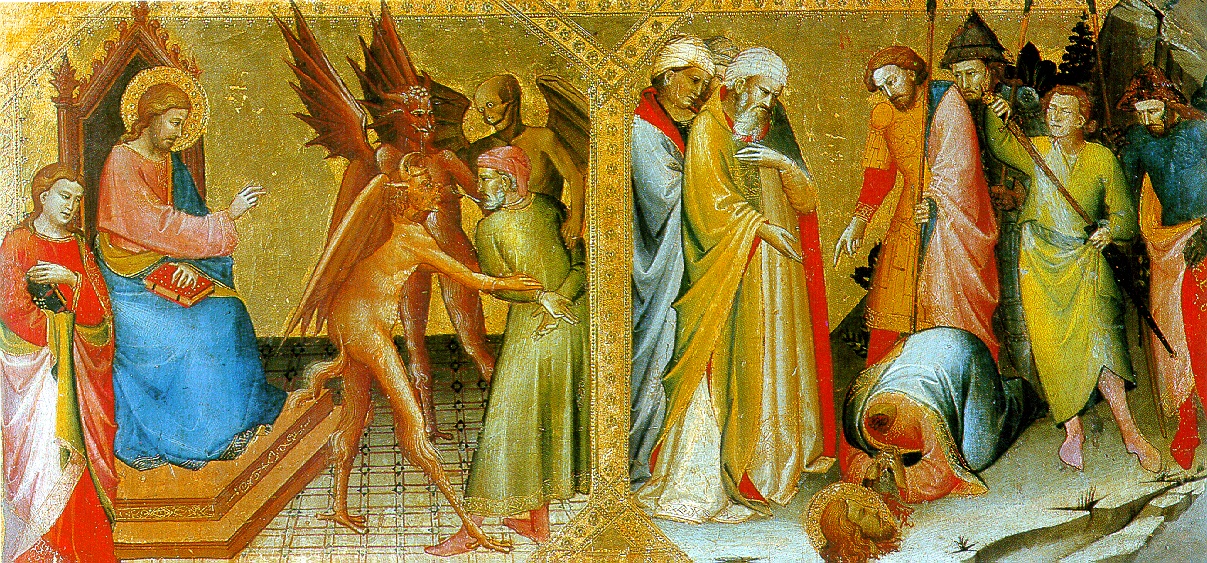
MONACO LORENZO
Saints Jacob Starshego and Germogen. Siena, 1365/7 – Florence, till 1426
Wood, 34 x 68 cm. INV came to Louvre in 1814. 29 (MN)
Parisian school
This amusing as at a polecat, cross-section is the earliest authentic portrait (from reached us) in the western painting. In other words, John II (Kind), king of France of are the first in the French art work of this genre made out of communication with any plot as it was characteristic of manuscripts or a sculpture.
The king who was born in 1319 is provided here by approximately forty-year-old person with signs of a premature senility. The portrait could be made in London in 1359, during its four years’ abiding in captivity after the battle of Poitiers lost in 1356 to British. The court painter of the French king was in case of him and in captivity. Later, when the person who replaced him as the hostage ran away, Ioann returned to England to save the honor; it was placed in the Savoy palace where he also died in 1364.
Ioann Dobry’s portrait accompanied by the signature could be one of four parts of a poliptikh where also images of his son entered, Charles V (between whom the portrait of the died father was passed), German emperor and the English king. On behalf of the monarch there is a certain simple cunning that does not contradict the historical chronicles describing his reign. Only the prudent flatterer could call “Dobry” him. The only thing this worthless monarch managed that best – so is the portrait reserved by it which opened the history of the French painting of Modern times.
Crucifixion of with scenes of Passions and the Anastasis – a pattern of absolutely other plan; it was reserved by Ioann’s son, king Charles V as an altar for cathedral in Narbonna whose shutters opened only for the period of Quadragesima. This work is made about fifteen years later, than Ioann Dobry’s portrait, but in his graphic style is something the close to legiblly revealed portrait circuit. A crucifixion, which is flanked by figures of donators – the king Karl and his spouse – are selected with the frame canopy; at the left and on the right prior and subsequent events are provided. The scenes which are not separated by the architectural frame overflow one in another; repeating cruelty in scenes of Passions is allowed by tranquility of adoration. The dramatic nature of the story is passed with a rare poetic force.