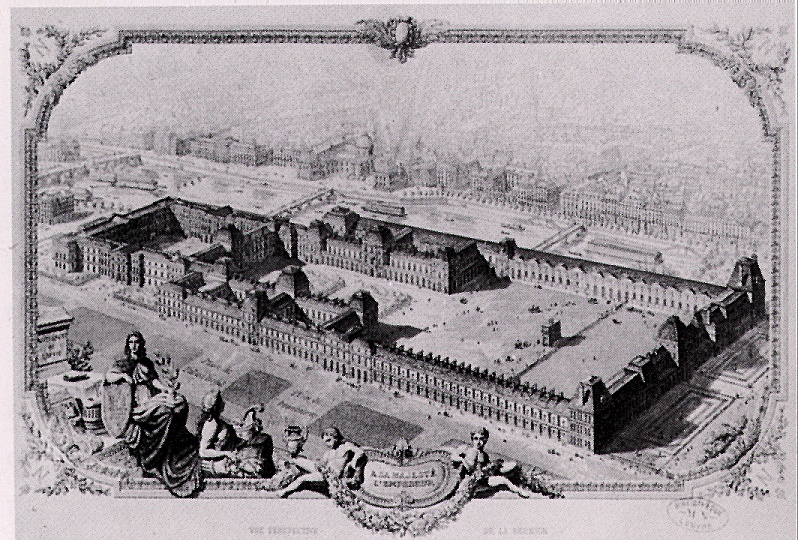
PENOR R.
Initial strong hold Louvre from which only the bases remained occupied the fourth part of the territory of the present Square yard (at the left). At the time of Napoleon it is parallel to the Big gallery stretched along the river, were the buildings which formed a row of the small yards are added. The Tuileries palace is on the right.
(Engraving. Library of Louvre, 103. MN)
And though the Tuileries palace could be recovered, this character of the hated regime of Napoléon III in 1883 was sorted. Its corrupting led to education between the Pavilion of Mars and the Pavilion of Flora of the free space thanks to which today the unique prospect which is stretching from the East for the West and completed in the distance with the Triumphal arch at Etual Square is offered us.
As soon as Louvre stopped being a residence of the power, its destiny was defined. Behind another administration rooms of the palace passed one to the museum; there was an opportunity to continue seating much of the grown collections and their exposure. At first the State halls of Napoléon III, in 1905 were occupied. The museum of decorative arts was given the Pavilion of Mars and the side panel adjoining it, and in 1969 – the Pavilion of Flora. A pressing forward to improve show of collections and more widely to use technology innovations in museum life it was dictated by the fact that collections of Louvre permanently increased and precipitantly the flow of visitors increased. For these years many exposition projects were realized, and the culmination of these serial steps it is possible to read mastering by the museum of the extensive locations belonging to the Ministry of Finance.
Such is in general architectural history of Louvre begun eight centuries ago and which underwent the last stage literally before our eyes. The patterns provided in an album make the main part of museum collection. The uniqueness of collections of Louvre, on the mammon and an encyclopedic completeness comparable only to three-four museums in a pattern, is emphasized with historical value of the building – one of those monuments which are in essence important in a comprehension of the country, society, culture. In addition to the great moments of political history and history of construction reflected in facades, as a part of patterns of this or that gallery, in a twiddle of the building or imprinted on the aged engraving which informed us of an echo of the left era, Louvre resurrects particular aspects in the history of tastes, moods, creative imagination – all that today’s historians only learn to give an assessment to. And it is real, not it is a leah the building “museum” – a concept for Europe not new, but once applicable only to aristocratic meetings of rarities and works of art, available few people realizes in eyes of general public idea of a word? The leah is not here, in these halls across which also we pass today, generations of artists and fans of art experienced joy of comprehension of art, pleasure to them, and sometimes – and a destruction force of rebellion (as many of them shouted “to Burn Louvre!”)?
These opening speeches are dictated not only by respectful commitment to the past – Louvre is also open for Y.M. Pei, as well as for Delacroix. They are dictated by recognition by all of the felt uniqueness which shall remain forever.
Collection history
Collecting of works of art in France was read by essential accessory of the monarchy. It was some kind of sport – same what for the English kings was saltuses. Collecting meant possession of royal privileges and until the French king had no funds for it, a role of the collector such governor as the Duke of Berry assumed. At the beginning of the 15th century the duke assembled a set of carpets and patterns, and a collection of the illuminated manuscripts – such as 0¤ ¤ _0_1_0 “The magnificent Books of Hours” – 0¤ ¤увековечила _0_0_0 a name of the duke Berry. It was attracted not only by works, but also artists, and there were no cunnings to which he would not resort to achieve the desirable. He promised the miniature painter Paul Limbourgou even the wife. Outrunning the time, the duke attached to art that significance, and to artists that provision who only began to be shown in Italy. In the north gradually there was more and more apparent a priority of the Italian art and the Italian art craft. At first on these works looked as at the rare things intended for collectors, but exciting imagination soon art values of Italy and that luxury which was looked for there became one of incentives by the beginning of military campaigns to this country.
At once after this patterns of artists of the High Renaissance and their copy began to come to France. Triumphal entry of Louis XII into Milan in 1507 was imprinted by Leonardo da Vinci who received royal pension and was received on royal service as an artificer officer. In the pressing forward to receive not only great patterns, but also permanent presence of the greatest master Louis XII (rule 1498-1515) followed in the same way, as the Duke of Berry century earlier.
Most remarkable “plot” in art of the French Renaissance was the person of the king. Francis I (rule 1515-1547) was truly a person of the universal spanning – both the patron, and the captain of the host, and in it it resembled the opponent from Urbino, the duke Federigo da Montefeltro. Huge energy of Francis I affected in nonmeasurably increased significance which he attached to the yard, the army and the collection. Francis laid the foundation of the French national collection which placed in the new royal castle in Fontainebleau. For its finishing the Italian masters who turned quite coarse building into a remarkable monument of the Renaissance style outside Italy were invited. In 1517 Francis I lodged da Vinci near Ambuaz Leonardo. All patterns which were at the artist at the time of his death which followed in 1519 including the work which we know Mona Lisa carried over the king. (All nineteen Italian patterns from Francis collection and are today in the Louvre collection.) Option (without clothes, nowadays in Shantiyi) became a sample for intimate half-length portraits of court ladies which made the main part of orders to artists of early school of Fontainebleau. Apparently, Francis portrait attributed now to Jean Cloue Low was the first French operation in a collection. The Titianesque portrait of the king was made on Benvenuto Cellini’s medal as at zaalpiysky monarchs it was not accepted to come into direct contact to the artist.
Patterns had value which is rare for Francis I when it was given them before. Fontainebleau was decorated by Rosso Fyorentino (1494-1540) and Francesco Primatichcho (1504/5-1570) many works, stukkovy sculptures which exceeded in the elegance everything that was ever made in Italy and also the separate cloths intended for quiet contemplation and hanging in locations of baths. This meeting became the main source of new art style in Northern Europe, and France – the leading cultural power, and it any more will never lose this role.