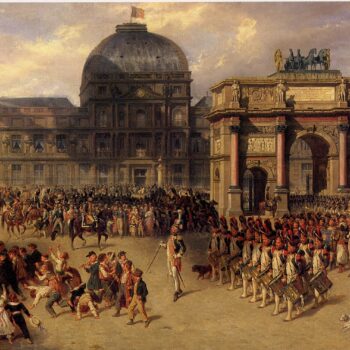
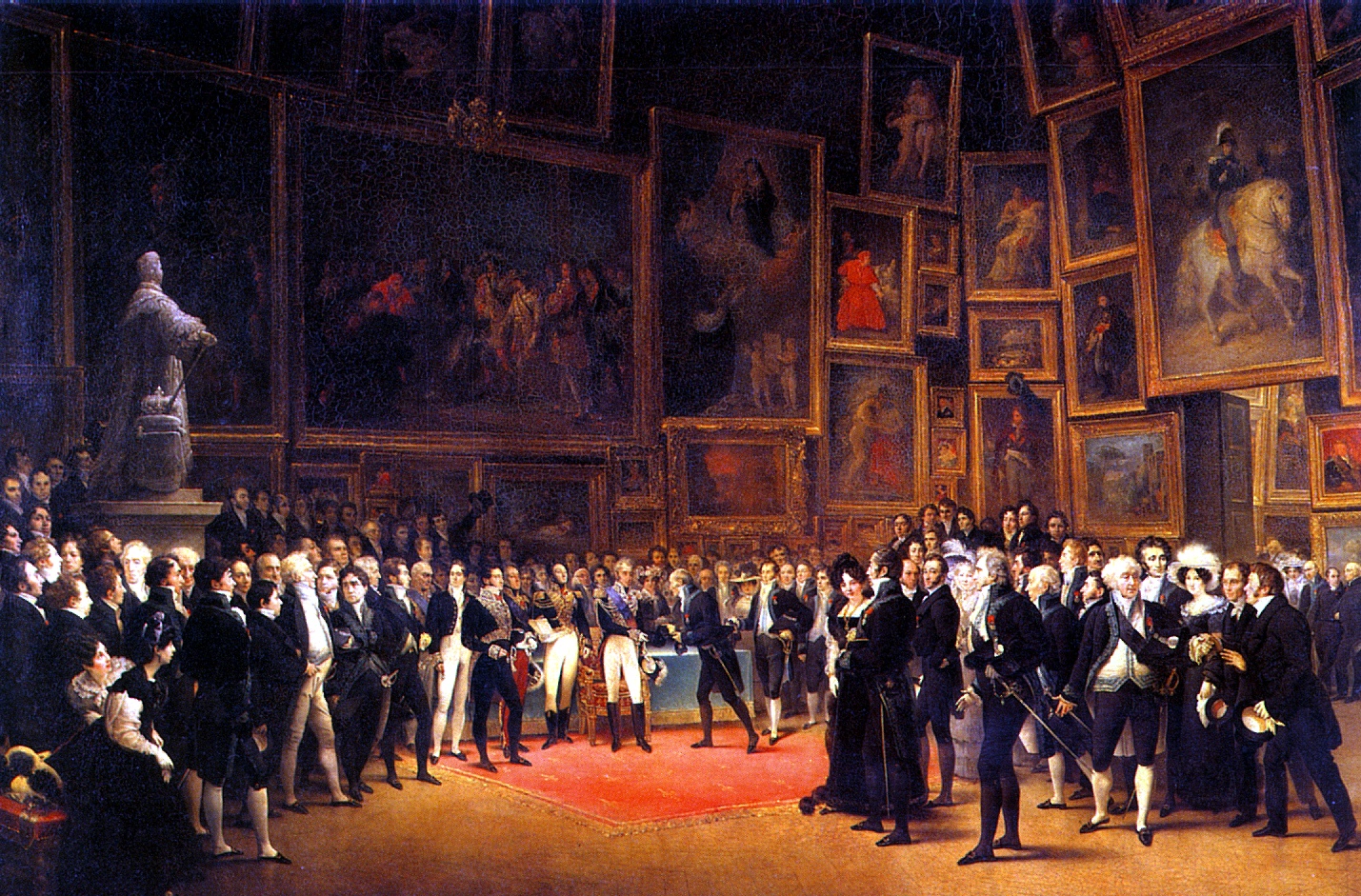
HEYM FRANÇOIS JOSEPH January 15, 1825 Karl X awards the artists exposed in Interior of 1824. The king hands feed medal after St. Michael to the sculptor Kartelye.
(Louvre, INV. 5313. MN)
Some of the pictures painted in luvre workshops were acquired and hanged out above, in Big gallery from time to time.
Henry IV who very much made for Louvre was killed in 1610; for a farewell ceremony the coffin with his body was exposed in the Hall of caryatids. All structural undertakings of his widow, to Maria Medici (1573-1642), to us did not remain, but presence of her person was shown – and shown more deeply, than at some other monarch – in the composition of a luvre collection. In 1621 for decoration of the Luxembourg palace it reserved to Rubens a series of huge canvases which explicitly explained her life and its progress, and indirectly reflected its self-glorification and self-justification. This cycle was fated to become the most brilliant illustration to management skill the state ever executed in painting (see).
The art priority of France was predetermined by activities of three of her great ministers – Richelieu (1585-1642), Mazarini (1602-1661) and Colbert (1619-1683). Their commitment was unshakable. Both Mazarini, and Colbert, each of them, was the secretary, the agent and the fellow-heir of the predecessor. The cruelty in methods of acquisition of works of art and in that intellectual power which they had over minds of others in principle was selfless as ministers were inspired by the ministering to the monarch hoisting prestige of all France. Royal collections for the French ministers were the key to creative potential of the royalty. Mazarini had reputation of the person greedy, however neither he, nor other ministers assembled a collection only for himself. All meetings of Richelieu were huge. They filled the palace of the cardinal which passed to Louis XIII and remade by the queen Anna Avstriyskaya for her relatives. The collection was transferred from there to avoidance of those falsities which could happen to the building. The best patterns and sculptures – Michelangelo “Slaves”, allegorical patterns from Studiolo Isabella of D’Este and Poussin’s “Bacchanalia” – were purchased for the family lock of Richelieu in Poitou which was going to be rebuilt completely; all these operations are in Louvre now. The broderie anglaise never saw the lock, but he understood that for similar masterpieces new majestic interiors are necessary. It is an anticipation of the architectural magnificence making us tremble and in which border works of art will appear in Versailles later.
Within one year two events took place one behind another: Mazarini became a cardinal, and to a throne there ascended Louis XIV (rule 1643-1715). To Mazarini collecting of painting meant in life, apparently, more, than to Richelieu. He had purely Italian passion to good art, and the king took its advices. Mazarini tracked all sales of the European collections. France is obliged to him (and also to the banker Eberhard Jabach) by purchase of the best part of the collection of Charles I sold by England in 1649-1653 – during the period which matched an era of the French Opposition because of which Mazarini was necessary to endure ejecting. Huge affection of Mazarini in the collection can be felt, reading the well-known description of its heart-breaking farewell to it some days before demise. Since 1661, after Mazarini’s death, his sobiratelsky initiative was undertaken by the French king. Personally managing the country (unlike the father), Louis XIV made also protection arts a crown law and a debt. Any monarch did not know as well as he, art of the time. Louis XIV read awareness in questions of art mandatory for the governor. He generous refused to inherit all Mazarini collection, but purchased the best works – Raphael, Titian and Korredzho’s operations. Purchase of History be Hans Zebald Bekham by it bears to latitude of his art tastes.
Change was striking. Purchases for precipitantly expanding collection were made by personally king. Works by the modern artists – Claude Lorrain and Poussin were among these purchases, for two-three years after Rembrandt’s death his operations skupatsya. Moreover: from international Baroque style Louis adopted a concept of style, having realized its value for an image of the kingdom. Said that he played a role of the king as only the ingenious actor could perform it. Its own taste gravitated, naturally, to art court, to distinguished – as at Antonis van Dijk – the executed flattery, but despite of it, Louis XIV bought the modern French operations even more actively, showing, thereby, care of prestige of national art.
The general inspector of finance Colbert directed tax policy of the country and dug up resources not only on unreasonable expenditures of the Versailles yard, but also on projects on enhancement of Louvre which dilapidation horrified the king. Palaces and their contents were a heavy economic burden for the country – it what in the Middle Ages was construction of cathedrals (this analogy arises by itself here). Deep affection of the king in Versailles left Louvre in a shadow. Colbert, in return, unshakably trusted in Louvre as in future national museum. It acquired works which Mazarini and Yabakh did not manage to purchase; thanks to it the foundation of an engraving meeting of which before nobody thought was laid. The active relation of Colbert to new acquisitions bears to a pressing forward to replenish collections. The ambassador of France in Venice got permission to purchase two larger cloths of Veronese which are in Louvre also now at the Venetian senate; Colbert nearly managed to intercept Raphael’s cardboards which are nowadays in London. Within twenty one years the collection increased from two hundred canvases to two thousand works.
The artist Charles Lebren (1619-1690), being already the director of Royal Academy of painting and a sculpture, this important organization of vocational training and intellectual polemic and also the principal of the Royal manufactory of tapestries making carpets and a house situation became the director of the Royal office of painting. Together with Colbert they resurrected old intention of Richelieu to turn Larger gallery into collection of paintings for tutoring of artists, having integrated the works dispersed on different royal palaces there. At the same time Lebren worked on magnificent design of luvrsky Gallery of Apollo.
In the XVII century the Fontainebleau collection remained invariable as memory of its founder, the king Francis I. Probably, because of deterioration in safety of the patterns which were near the swimming bath the saver – the grandson of the artist Luka Leydensky was assigned. This position became hereditary, and several decades later according to Colbert’s instruction their saver – the grandson of the first saver of a collection also moves to Louvre together with patterns.
In 1674 the preliminary works in Louvre had to be paused. Versailles shall become the royal residence, the fate of a royal collection of patterns was predetermined too. As “Mercyur de Frans newspaper wrote on December 6, 1681, the king “awarded Paris with the presence and visited aged Louvre to see the Office of painting <…> Its Majesty found everything that is under authority of his first artist, in a magnificent order”. Having voiced approving words and having selected fifteen patterns for own apartments, “Its Majesty left with feeling of deep satisfaction”.
It was the gala day. Louvre became national public gallery which single visitor was a king. Two years later Colbert died, Lebren lost the fast and influence, and Pierre Miniar (1612-1695) became his heir.
The austerity mode which followed after intensive collecting of Louis XIV caused the growing discontent. The Golden Age of the French painting which fell on the 18th century did not find the promoter on behalf of Louis XV, having remained not represented and in a royal collection. Patterns of the Royal office of painting placed in palaces, the Larger gallery was occupied by plans of strong holds of France. Attracted considerable interest 0¤ ¤grand _0_1_0 siede – 0¤ ¤живопись _0_0_0 the 17th century which masterpieces decayed in stock. Need for them was especially notable in view of all of obvious decline of historical painting – the most dear at that time a genre. No attempts to acquisition of works from the sold large collections were made.
The public criticism of all these actions – to be exact, inactivities – was something new. The future of a royal collection became a public affair now. There were pamphlets, and the people listened of the Complaint to unavailability of a collection led in 1750 to a solution to open the temporal museum in the Luxembourg palace. It opened for the garden leave twice a week, in the first or in the second half of day seasonally. Switching on in exposure of the informative show of a method of restoration of painting was quite unexpected: the pattern of 0 Cinsious byAndrea del Sarto’s transferred to a canvas from the board which underwent a destruction was shown. This board became an exhibit too.
Louis XVI (1774-1793) set up a peculiar record on new arrivals in the museum. All collections were replenished, systematization on the expertize of quality of works which is most made for that time is carried out. Graf D’Anzhiwiye holding post of the director of Louvre in 1774 actively resurrected classicism wherefore historical painting and sense of beauty were guided by this style. D’Anzhiviye systematically filled lacunas in a collection, trying to subordinate it to the continuous chronological row.
Since 1725. The royal Academy of painting and sculpture began to hold the exhibitions in luvre Square Interior. Since then the regular academic shows forever received the name of Interiors. Square Interior witnessed all turning points in the history of the French painting. Meanwhile, thanks to D’Angiville the composition of a collection strongly extended at the expense of the Netherlands schools, interest in which for the first time arose in England. The large sum was selected for acquisition of the Dutch patterns from the English collections.
At that time cherished the dream of creation of the museum in Big gallery could be fulfilled by Encyclopaedists and educated people. The royal collection was actively replenished by performing the French painting of the midpoint of the 18th century awarded official diplomas of Academy. But time went, and the meeting remained the property of the king. And when in 1779. The status of the royal residence was returned to the Luxembourg palace, patterns returned to a store room again. Among other in rolls also cloths of a rubensovsky cycle of patterns “Maria Medici’s History” which were also read by a part of future museum were rolled.
The museum was supposed to be placed in Big gallery, and announcements about it sounded more likely optimistically, than surely: “There is an intention to turn gallery into the Museum where the patterns belonging to the King, nowadays being in storages will be shown… Allow to voice hope that we will see completion of this nice project…” – it was said in the “Paris guide for fans and foreigners” the abbe Thierry which is exhausted in 1787. Reconstruction progressed very slowly, and as it occurred often in case of the mode of that time, money suddenly came to an end. The most various scientific Academies occupied locations of Louvre everywhere where could only capture them. The artist, the master of an architectural veduta Hubert Robert (1733-1808) became a saver of gallery. He took the duties creatively and continuously wrote types of Big gallery as if provoking a question that with it will be. Hubert Robert figured it in the form of perfect art gallery, with the skylight and majestic space subdivided into large compartments. In other pattern he presented Larger gallery in not regenerated and launched form, dark and extremely cluttered up. Further it figured it in absolutely unsuitable type looking as a ruina. At the same time its imaginary “reconstruction” in itself were very beautiful (The project of design of Big gallery of Louvre in ruins.
This series of patterns of Hubert Robert represents one of unique gaining the French art. Involved in problems of Big gallery, he well understood – understood even more better, than Diderot and authors of pamphlets – its potentials as museum which nobody realized throughout one and a half more centuries. Louvre what it became is the embodiment of a dream. When Hubert Robert’s hypotheses were compared, it was easy to see what appearance of Louvre is most preferable, and the first steps to this ideal option were taken. Nevertheless, the reconstruction corresponding to Robert’s figures exposed in Interior of 1796 was fated to be completed only in the XX century. France of a boundary of the 18th and 19th centuries was not able to wait for exercise of all these plans.
Revolutionary initiative – the most impatient of human moods. The idea of release from the royalty granted to everyone the right to lay claim on royal privileges. The authoritativeness of the monarchy became that line which to step and the common people aimed. The royal collection shall belong to the people and without uniform month of postponing. The decree of July 27, 1793 it was decided to open Louvre in fourteen days, as occurred on August 10. The audience was allowed on three of ten days of the week of the revolutionary calendar. Five days it was possible to be engaged in copying and two days were left for cleaning. It is curious and demonstrative that on the first place need of tutoring of artists moved forward. Of course, the gallery was not ready to it and was forced to be closed for repair and corrections soon. A part of locations was ready by April 17, 1799, remaining is complete by July 14, 1801.
Nevertheless, the Main Museum of art (Louvre so began to be called) was noticeable achievement of the time. It opened in the first days of the mode of terror when France was at war with the whole Europe and besides it is teared by a civil war. However the museum managed what the monarchy could not make for forty years. Only three quarters from 735 patterns entered from a royal collection. Remaining made confiscations of churches, the operations awarded diplomas of the Academy abolished in it it is a high time, or from the property of emigrants (in particular, the duke Richelieu) who were in special storage, guarded from claims of creditors. The main Museum was, truly, the single correct undertaking of the new power in France. Jacobeans led by Zh.L. David achieved the goal, having shown that culture which was once remaining for pleasure of the monarch is the natural right and property of all mankind. They achieved a peculiar sublimation, having transferred revolutionary envy of common people to the feeling of brotherly pride of citizens justifying assignment of crown mammons by them.
Each citizen visiting Louvre was a fellow-heir of a collection of the French kings. It was the indirect owner of what the common people could not dream earlier of. If he did not wish, then could not encumber himself with so distinguished inheritance as art. Revolutionary achievements had the unique potential unchaining imagination. British invented revolution, but they could never imagine its hidden potential. They never understood the art value of that royal luxury which to them was shown by Charles I (and which with the same arrogance was shown by the French monarchy) to see in it and something other, allowing to expand the creative potential of the person.
Already in the period of the Directory (1795-1799) the general Napoleon Bonaparte understood that where his armies went, they shall capture the most glorified art monuments for benefit of the Main Museum wherefore the sovereign right to all arts owed pass to France to approve and decorate the kingdom of freedom. The initial batch of art values arrived in 1794 from the Netherlands. Two years later, during the Italian campaign of Napoleon, it was followed by patterns from Parma, Bologna, Modena and Cremona. In 1797 and 1798 its army plundered Venice and Rome. The German and Austrian galleries were robbed in 1806 and 1807. Caravans of masterpieces from all occupied countries were tightened to Louvre. There arrived not only patterns, but also the imposing sizes a sculpture, various rarities and the whole menageries of exotic animals, and all this created the atmosphere of an ongoing pandemonium and national triumph in Louvre.
It was clarified soon that the huge gallery could receive no more than a half of patterns which were concentrated there. One thousand more was placed in Versailles where loss of a royal collection, earlier there was felt as being located. Organization in Versailles in 1793 was some comfort. The special museum in case of Ekol Fransez. Actually this museum became a store room of works of the French painting of the minor value. In Louvre confusion was neutralized thanks to a permanent exhibition of the latest arrivals in Square Interior from where they moved then according to systematization to Larger gallery. The former chevalier de Non who was flexibly changing the policy depending on change of promoters – from the Pompadour and Burbonov to Napoleon and who was in time to become the citizen Vivan-Denon became the most famous general director of the museum. He received the fast in 1802 at the age of fifty five years, but proved to be fully to the appropriate tasks of the position and even shared in military campaigns of Napoleon. At its insistance in 1803 the second consul offered, and the first consul agreed to rename the museum into Napoleon’s Museum. Then the name of Bonaparte was for the first time isolated, having realized in the name of specific organization that already indicated Napoleon’s transition to line items of the imperial dictator.